The Coldest City Winter Manual
Keep your house warm the way we do at minus 83, and take $300 to $600 off a winter of heating.
You do not need a contractor and you do not need a gadget. You need a caulk gun, a few rolls of things from the hardware store, and one evening to begin.
It works the same whether you heat with gas, oil, electric, a heat pump, a boiler or wood, and whether you own the house or rent three rooms of it.
$19 once · PDF, 10 chapters, 114 pages · in your inbox the minute you pay

What you'll be able to do with it
Five things, in the order we do them.
- Find where your heat is going in one evening.A stick of incense, the wet back of your hand, and a leak map of your own house.
- Seal the top and the bottom of the house for under $100.Caulk, foam and weatherstrip. No ladder taller than a step stool.
- Set any heating system so it stops wasting.Furnace, baseboard, heat pump, boiler or wood stove. Each has its own plain rules.
- Sleep warm in a cool room.The bed built from underneath, the way my grandmother built hers.
- Get through a night without heat, and keep the freezer.One room, hour by hour, and what to do with the food at each stage.
Who am I
I have spent every one of my winters here.
My name is Sardana. I am thirty-four, I was born in the coldest city on earth, and I have never lived anywhere else. In January it reaches minus 83 Fahrenheit, minus 64 Celsius.
I grew up on the fourth floor of a concrete apartment block that stands on stilts over the frozen ground, heated by the city's steam plants. Every school winter holiday I spent at my grandmother's log house in a village on the river, a day's drive north on the winter road. It had one brick stove in the middle, and ice blocks cut from the river stood stacked by the door for drinking water.
My mother raised three children through those winters and checked each of us at the inner door before we went out. At 27 I moved with my husband into the wooden house at the edge of the city where I live, with an entry hall and two doors. My mother lives fifteen minutes away. Every October she comes to inspect my windows.
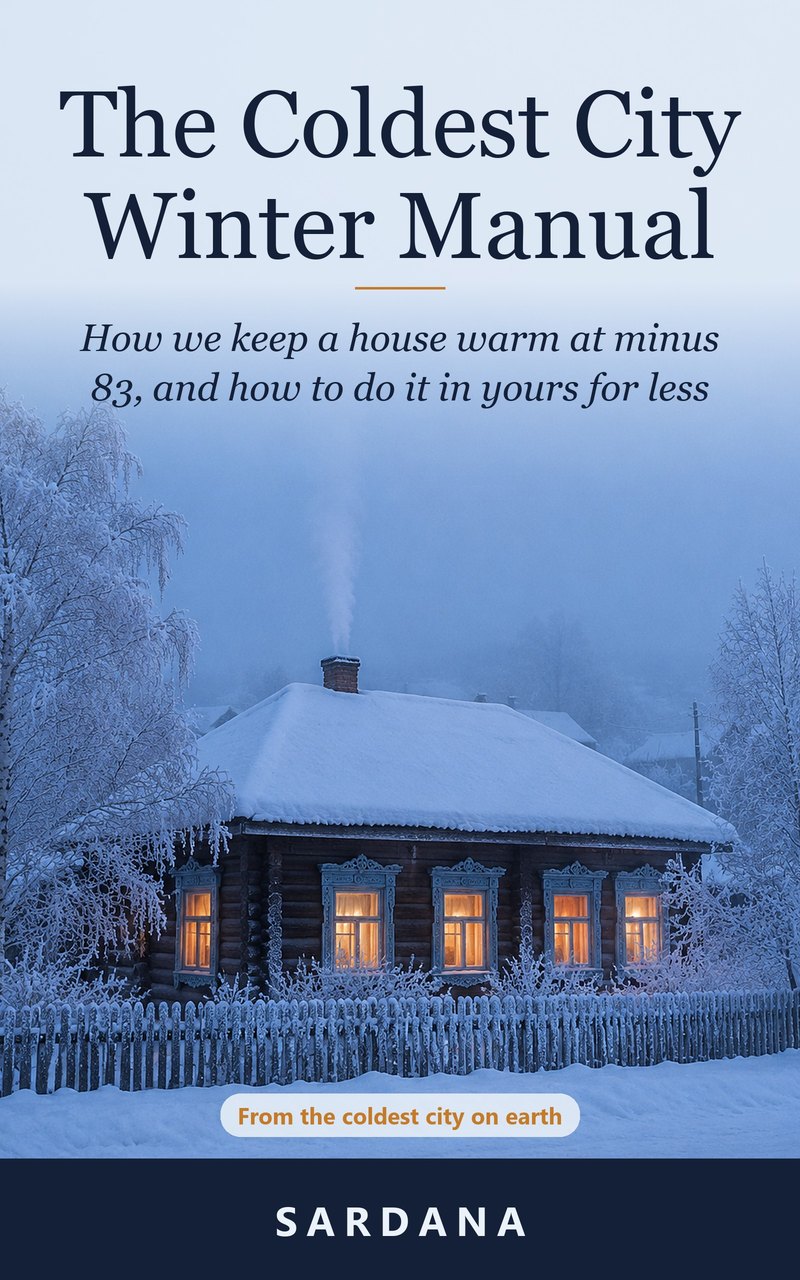
The manual
$19 once. No subscription. Yours forever.
In your inbox the minute you pay.
What you get for $19
- The Coldest City Winter Manual.PDF, 10 chapters, 114 pages. Read it on a phone, a tablet or a computer, or print it.
- The leak map and a checklist in every chapter.What to do, in order, with hardware-store things and their prices.
- The hour-by-hour plan for a night without heat.The first hour, the one room, the safe heat, the pipes, the box by the door.
- The fall calendar.The whole book on one page: early fall, before the first freeze, the coldest week.
Pay once · yours forever
Secure checkout
If it does not save you the nineteen dollars this winter, write to me and I will refund it.
What I actually know
The cold does not come in. The warmth walks out.
My mother has a saying, which she had from her own mother: the cold does not come in; the warmth walks out, so find the door it uses. She is exactly right, and most Americans have it backwards.
Your house is a chimney. Warm air rises, collects under the top-floor ceiling and leaves through every crack up there. Every cubic foot that leaves at the top is replaced at the bottom, pulled in under the doors and along the foundation. That is the cold you feel at your ankles.
The window is where you sit, so the window is where Americans start. That is the wrong end. The leak is at the attic hatch. That is not a cold house. That is a house with a hole in it.
What this lets you do
- Close the attic hatch, the worst place in most houses, from a step stool.Foam weatherstrip tape $5 to $10, a panel of foam board $8 to $15, two latches $3 to $5.
- Seal the seam where the house sits on its foundation, and every pipe and wire that leaves it.A tube of caulk $4 to $9, a can of spray foam $6 to $10.
- Stop the outlets on your outside walls from leaking.Foam gaskets behind the cover plates, $3 to $6 a pack. You touch no wiring.
- Close the blade of cold under the front door.A door sweep, $10 to $20, four screws, fifteen minutes.
- Give a single-pane window a second pane.Plastic window film, $3 to $6 a window. The glass you sit beside goes from about 25 degrees to about 50.
The arithmetic
You make the nineteen dollars back in the first cold month.
I promised you numbers, so here they are, added up for one winter.
| What you did | Saved in one winter |
|---|---|
| Chapter 1: sealing the air leaks | $60 to $120 |
| Chapter 2: doors and the entry | $30 to $60 |
| Chapter 3: windows | $50 to $110 |
| Chapter 4: heating the rooms you live in | $40 to $90 |
| Chapter 5: thermostat, filter and registers | $90 to $170 |
| Chapter 6: humidity | $30 to $50 |
| Total | $300 to $600 |
This is one ordinary house in a cold state with a winter heating bill of about $1,400; the calculation is in the book, so you can run it on your own bill.
GET THE MANUAL $19Before you order
Six plain questions.
What am I actually getting?
A PDF of 114 pages in ten chapters, in your inbox the minute you pay. Every chapter goes the same way: how we do it at minus 83, why it works, how to do it in an American house with hardware-store things and their prices, the mistakes, and a short checklist. Each chapter also tells you what not to spend money on.
How fast can I use it?
Tonight, if it is 40 degrees or colder outside. The leak hunt in chapter 1 takes 45 minutes to an hour and needs a pack of incense at $2 to $5, a roll of painter's tape, a pencil and a sheet of paper. Closing the worst leaks at the top and the bottom of the house is about a weekend.
I rent. Is this for me?
Yes. The chapters on doors, windows and heating each have their own lines for renters: what you can do without asking the landlord. A slide-on door bottom uses no screws and leaves with you, rope caulk peels out of a window in spring and leaves nothing behind, and a curtain on a tension rod leaves no mark. In an apartment with one outside wall, the windows are most of the heat you lose.
I have a heat pump, oil, or electric baseboard. Does it apply?
Yes. Chapter 5 has a plain section for each system: gas furnace, oil furnace, electric baseboard, heat pump, boiler with radiators, and wood stove. The rules are different for each. A heat pump, for one, gets a small night setback of 2 to 3 degrees and never more. Everything else in the book, the leaks, the doors, the windows, the bed, is the same whatever you burn.
Do I need tools or a contractor?
Nothing in the book needs a contractor. You need a caulk gun at $6 to $15, a screwdriver, a hair dryer for the window film, and a step stool. The book says plainly which few jobs belong to a tradesman, such as the gap around a furnace flue, and what you can check yourself before you pay for a house call.
Is this the same as the videos?
It is the manual I talk about in the videos. A video shows you one thing. The manual puts all of it in order, with the measures, the prices, the mistakes and the checklists, and ends with one calendar for the whole fall.
Before you go, one method
The wet back of the hand and a stick of incense.
This is my mother's whole method, and you can do it tonight if it is 40 degrees or colder outside.
- Close every window and outside door. Turn the heat off at the thermostat. No fire burning in a wood stove or a fireplace.
- Turn on the bathroom fans and the kitchen hood. Now the house is pulling in through every hole at once.
- Stand on a step stool under the attic hatch. Light a stick of incense and hold it one inch from each of the four edges.
- Still air sends the smoke straight up in a lazy column. A leak bends it sideways, or sucks it into the crack.
- Wet the back of your hand at the tap and hold it where the smoke moved. The back of the hand feels cold better than the palm, and wet skin feels moving air at once.
- Turn the fans off and the heat back on.
If the smoke vanished into the crack, you have found the single worst place in most houses. The fix is foam weatherstrip tape on the ledge the hatch rests on, a piece of foam board glued to its top side, and two hook-and-eye latches to pull it down tight. $20 to $40, from the hallway, and you never enter the attic.
The other nine chapters are in the manual.
GET THE MANUAL $19Pay once · yours forever · Secure checkout